Society has never considered it a problem for younger women to be with older men—provided that they have enough fame, power and money to justify the relationship.
Although a lot has changed over the years, most people still look at relationships between older women and younger men through a different lens.
Let’s take a closer look at these relationship dynamics.
When it comes to having children, there are advantages in not waiting too long. However, most women want to ensure they have sufficient emotional and financial support before having children. In this case, a man who’s mature, experienced and well off financially is a perfect match!
From an evolutionary point of view, though, children want parents who are in a similar physiological condition.
When children grow up, this can become a problem. Why? As they grow older, women tend to focus more and more on their own needs in search of fulfillment.
As their children enter adulthood, most women come into bloom. They feel more confident. They know exactly what they want—and what they don’t want. Most importantly, they suddenly feel an increased need for sex. Unlike mothers and grandmothers of past generations, they also look much younger, thanks to modern ideas and innovations around lifestyle.
The biological and mental differences between men and women—which increasingly diverge from age 40 onwards—can become a problem in this phase of life.
Having made themselves comfortable in their romantic relationships, many men experience decreasing testosterone levels.
Statistically speaking, the life expectancy of men is about 8 years less than women. What’s more, studies have found that men in their 50s have 30% more brain shrinkage than women of a similar age.
Though of course this can vary from person to person.
For all these reasons, many mature women are beginning to seek out younger partners. Ultimately, they’re looking for someone who’s on the same wavelength sexually and psychologically. The older the woman, the more this desire comes into play.
Women over 50 who are physically active and know how to take good care of themselves tend to leave their male counterparts in the dust! (For more on this topic, see my post:BioAge ; How you can lower your Biological Age
Given this reality, it’s time we recognize couples in which the woman is 8 or 10 years (or more) older than her partner as “normal” and socially acceptable!
In this spirit, I’d like to encourage women not to shy away from considering much younger men as partners—and not to have any hang-ups about it.
Since older women are such a great match for them, younger men generally and genuinely love and take great care of them throughout the relationship.
Scientifically speaking, when it comes to our experience of the world, just 10% consists of actual events—the other 90% is our reactions to them.
This 90% varies as widely as people’s lifestyles in different parts of the world. The world is beautiful or terrible, depending on how we (want to) see it.
I’m not talking about extreme situations like war or natural disasters. I’m not talking about looking at the world through rose-colored glasses, either. What I’m talking about is focusing on the positive, and either accepting or working to change the negative. Instead of putting yourself at the mercy of a worldview, I’m talking about trying to shape your experience of the world as much as you can.
I’ll show you how to turn a half-empty glass into a half-full one.
Do you have an inner critic or partner who wakes up with you and serves up your worries for breakfast? Is your stress level so high that you have no idea how to bring it down? Are you unsure about how to deal with the fears that other people project onto you? What about all your “good intentions”—to exercise more often, eat healthier, and sleep better?
You’ll find answers to these questions in my posts on this site.
In the meantime, I’d like to share with you my 10 personal strategies for experiencing the world in a more positive way—and feeling better in the process:
After waking up, take some time for your morning rituals. Give your worries and problems a break. You gave them some of your time yesterday. Celebrate each new day as if it’s a gift.
Review your to-do list. Schedule a 10-15 minute break between each task to move and do some deep breathing.
Be grateful that you can experience the world in the first place. Try to look at it without judgment.
Once a day, do something that takes you out of your comfort zone. Try something new! It can be something small, like walking on an unfamiliar path or trying an unusual flavor of chocolate. In the meantime, check in with yourself: “How am I doing right now? What feelings are coming up—and why?”
Celebrate every success, no matter how small it seems. The key here is not to set the bar too high. Reward yourself with things that bring you joy.
Practice self-love and try not leave too much room for self-criticism. Choose to focus on your strengths and achievements.
Set aside about an hour each day to reflect on worries and problems. Write down 3 solutions for each problem. Choose the solution that most appeals to you and break it down into small steps, with a deadline.
If someone offends you, question their behavior. Why did they talk or act this way? What’s their motivation? Why did I react the way I did? Remember: most personal attacks are based on other people’s fears, lack of self-esteem, or projections of their own problems. Try not to take everything personally! Surround yourself with people who think positively. Avoid spoilsports and whiners.
Forgive yourself for your mistakes—and learn from them.
Forgive others for their mistakes—and learn from them.
Happy Dancing Antiaging Work-out barefoot on a green ground. Watch here how to stay fit and fexible without any equipment with dancing work outs! Click below on “read more” to watch a video!
The 10 best quick meals for long-term health and fitness!
These days, when it comes to cooking, there are three important benchmarks:
It has to be quick.
It has to be healthy.
It has to taste good.
Here are 10 recipes for dishes that more than satisfy all three of these criteria. Each recipe serves 2 people and takes about 15 to 20 minutes to make.
Russian Borscht Stew with Buckwheat
Russian Stew with buckwheat
1 medium-sized head white cabbage
1 fresh red beet
1 large carrot
2 medium-sized tomatoes
1 thick slice celery root
½ a leek
2-3 large mushrooms or 1 handful chanterelle mushrooms
150 grams buckwheat grains
2 tablespoons vegetable broth powder
Olive oil
Parsley
Slice the vegetables and the mushrooms. Boil 1 liter of water and add the vegetable broth powder to dissolve. Add the sliced vegetables, mushrooms, and buckwheat grains. Cook for 10 minutes at low heat. Finish with a generous dash of olive oil and a handful of chopped parsley.
Serve with a spoonful of hummus and/or sour cream.
Fish fillet (for example, smoked mackerel, as shown here) with FriedPimientos and Blue Cheese Porridge
Fish-Filet with mush potatoes and roasted pimientos
1 smoked mackerel
Alternative: use salmon or any other fish you prefer, season with salt, pepper, a tablespoon of olive oil, and a few drops of balsamic vinegar, then bake in foil for 20 minutes at 185 °
1 bag of green pimientos (a.k.a. pimientos de padron)
2 or 3 potatoes
50 grams of blue cheese
100 milliliters milk
Salt, pepper, and olive or rapeseed oil for sautéing
Fresh tomato slices for garnish
Remove the skin and bones from the mackerel. Fry the pimientos in oil with salt and pepper. Boil the potatoes in salted water, drain ¾ of the water, add the blue cheese and milk, and mash together with a fork or a potato masher.
Serve with a few slices of fresh tomato.
Vegetable Pancakes with Herb Quark, Hummus, and Mixed Green Salad
Feel younger with healthy food
Vegetable pancakes (or potato pancakes), hummus, and herb quark from the deli counter at your favorite supermarket
Salad ingredients: organic mâche greens (a.k.a. lamb’s lettuce), ½ cucumber, 2 tomatoes, green onion
2 tablespoons olive, sunflower, or MCT oil
1 tablespoon balsamic vinegar
Salt and pepper
Warm the vegetable pancakes in the oven at 180°C for 15 minutes. Combine the greens with the chopped cucumber, tomato, green onion, salt, pepper, oil, and vinegar.
Remove the vegetable pancakes from the oven, place on large plate, top with herb quark and hummus, and serve with salad on the side.
The Classic: Fried Potatoes with Eggs Sunny-Side-Up and Fresh Sauerkraut
Fried potatoes with eggs and sauerkraut-salad.
2 or 3 new potatoes
Organic eggs
150 grams fresh sauerkraut per person (barrel-cured is best)
1 or 2 green onions, chopped
Seasoned salt and pepper
1 tablespoon maple syrup
Caraway seeds
1 tablespoon flaxseed or sunflower oil
Rapeseed or olive oil for frying
Peel potatoes and slice them as you prefer. Place potatoes in a skillet with olive or rapeseed oil and chopped green onion and brown for 7-10 minutes. While the potatoes are cooking, combine the maple syrup, a pinch of caraway seeds, and flaxseed oil with the sauerkraut. Place the fried potatoes on a large plate with the sauerkraut on the side. Cook the eggs in the same skillet you used to fry the potatoes, sprinkling them with seasoned salt. Lay the eggs atop the fried potatoes and serve.
Red Lentil-Vegetable Soup
Red Lentil Soup with vegetables
500 milliliters organic vegetable broth
200 grams red lentils
50 grams fresh ginger
100 grams chanterelle or porcini mushrooms
200 grams broccoli, green asparagus, or another favorite vegetable
1 bunch of “soup vegetables” (1 rib celery or 1 piece of celery root, 1 leek, 1 handful curly parsley, and 1 carrot, as needed)
2 tablespoons olive or MCT oil
Parsley
Bring the vegetable broth to a boil. Rinse the lentils and add them to the broth. Grate the ginger directly into the broth. Wash and chop the mushrooms and vegetables, and add them to the pot. Cook for 10 minutes. Finish with oil and a handful of parsley.
Serve the soup with a spoonful of sour cream.
Tortellini with Jumbo Shrimp
Tortellini with Jumbo Shrimp
1 package fresh tortellini pasta
400 grams jumbo shrimp
1 green onion, chopped
2-3 cloves garlic
2 medium-sized tomatoes
4-5 marinated sun-dried tomatoes
100 grams whole green olives
1 chili pepper
1 tablespoon organic vegetable broth powder
30 grams of Parmesan cheese
Olive or rapeseed oil for sautéing
Add shrimp, vegetable broth powder, chopped green onions, olives, and chili to a wok and sauté in olive oil. Meanwhile, chop the garlic, sun-dried tomatoes, and fresh tomatoes. Bring a large pot of water to a boil, add salt, and add tortellini, cooking for about 4 minutes. Drain the pasta. When the shrimp are red and cooked through, add the rest of the chopped vegetables to the wok, and cook, stirring frequently, for about 3 minutes. Add the drained tortellini to the wok and stir to combine.
Serve in pasta bowls and garnish with freshly grated Parmesan.
Mixed Green Salad with Seaweed and Tofu
Green salad with seawead and roasted tofu
250 grams mâche greens (a.k.a. lamb’s lettuce)
2 or 3 medium-sized tomatoes
1 cucumber
1 ripe avocado
1 green onion
Seaweed salad from the deli counter
Your favorite salad dressing
200 grams firm tofu
50 milliliters soy sauce
Rapeseed oil for sautéing
Cut tofu in to large pieces and marinate for 10 minutes in soy sauce. Chop the salad ingredients and combine with the dressing. Serve on two large plates, spooning the seaweed salad over the top. Heat oil in a wok and cook the soy sauce-marinated tofu until well browned.
Arrange the browned tofu pieces over the salad and serve.
Kefir-Spelt Pancakes with Cottage Cheese
Kefir-Spelt Pancakes with cottage cheese
250 milliliters kefir
2 eggs
4 heaping tablespoons spelt flour
Cottage cheese
1 container fresh raspberries
1 tablespoon honey
Flaxseeds (about 1 tablespoon)
A pinch of salt
Butter, plus oil for cooking
Preheat oven to approximately 70°C. Combine the kefir, eggs, and spelt flour, and add a pinch of salt. In a small pan, fry the pancakes in a little oil, brush them with butter, and place them in the preheated oven on a plate to keep warm. In a bowl, smash the raspberries and combine them with honey and flaxseeds.
Serve the pancakes with cottage cheese and garnish with spoonfuls of the raspberry mixture.
Pasta with Stir-fried Zucchini and Mozzarella
Pasta with vegetables and Mozzarella
2 small zucchini
1 green onion
½ red bell pepper
100 grams of your favorite mushroom
2 medium-sized tomatoes
1 clove garlic
1 tablespoon organic vegetable broth powder
2 large balls of fresh mozzarella
30 grams Parmesan cheese
Oil for sautéing
Freshly ground pepper
Tagliatelle noodles for two
Cook the pasta in boiling salted water according to the package directions. Drain. Chop the vegetables, mushrooms, tomato, and garlic and sauté in a large skillet with oil, vegetable broth powder, and ground pepper. Add the cooked, drained pasta to the skillet and stir well to combine.
Divide into two pasta bowls, top each with a ball of mozzarella, and sprinkle with freshly grated Parmesan.
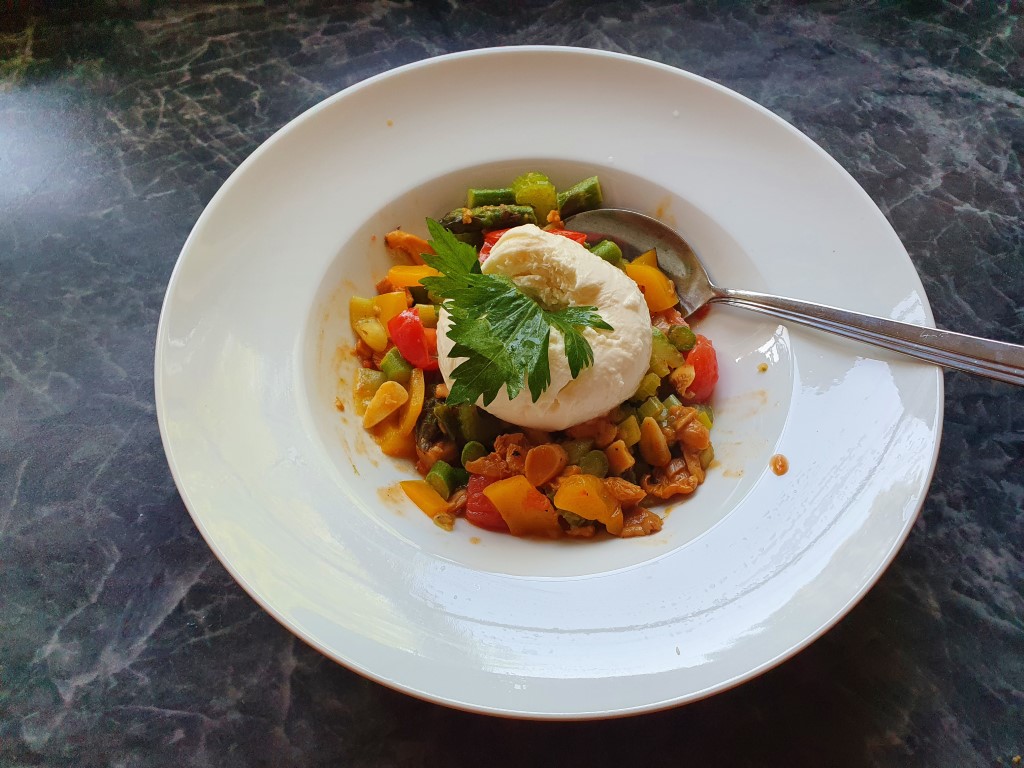
Sautéed Vegetables with Chicken Strips
Roasted vegetables with chicken strips
300 grams boneless, skinless chicken breast
300 grams green asparagus (or another favorite vegetable)
Green onion
1 yellow bell pepper
1 rib celery
1 clove garlic
2 tablespoons olive oil
Balsamic vinegar, approximately 1 tablespoon
1 tablespoon organic vegetable broth powder
1 medium-sized tomato
Marinate chicken breast in 2 tablespoons of olive oil, 1 tablespoon of balsamic vinegar, and salt and pepper to taste for 1 hour. After marinating, cut chicken breast into strips.
Chop the asparagus (or other vegetable), green onion, yellow bell pepper, celery, and garlic and sauté in olive oil for 5-7 minutes. Divide the vegetables between two plates. While the pan is still hot, brown the chicken strips for 3-4 minutes over high heat. Place the browned chicken strips on top of the vegetables. Garnish with slices of fresh tomato.
I’d like to dedicate this article with gratitude to my male readers.
Just about every man strongly identifies with his greatest asset. How could it be otherwise?
As long as he’s happy with the size, and with the way it’s functioning, all’s right with the world.
But if there’s even a minor problem in this area, it can be cause for concern. And it’s far too easy for “minor” problems to quickly develop into major ones.
Why? Beyond their physiological function, we also expect the genitalia to perform labors of love. Preferably on demand. Otherwise, a man feels inferior.
At this point, I’d like to share something that might be hard to believe: If your sexual partner is a woman, neither size nor functionality matters to her!
When a woman goes to bed with a man, her first priority is to have things unfold in a way that’s satisfying for her. So if you’re looking to please a woman, a totally different set of qualities comes into play!
For one thing, it takes longer for women to get turned on.
In fact, if we compare the time between the start of stimulation and climax, it’s about 3-7 minutes for men and 15-30 minutes for women.
This is why it’s important for men to find good ways to bridge this time gap. A woman doesn’t usually have to do much to bring a man to climax. But most of the time a man has to make an effort to bring a woman to her sexual peak.
In this case, mental and physical endurance are essential! Not to mention vitality and loving care.
The fact is, if you’re at a healthy biological age, nothing can stand in your way when it comes to having a good love life. One of the keys is having generally good circulation, which enables blood to supply nutrients to all parts of the body, helping it function at an optimal level. When this is happening, you naturally feel good.
Besides paying attention to your biological age, keep this in mind: if you want someone to think of you as a good lover, it’s important to start off by asking them what they want in bed!
This is how to be a good lover to a woman:
Create a warm, cozy atmosphere
Incorporate some prolonged, imaginative foreplay
Use your hands and mouth to bring her to climax
Only then is it your turn!
Voilá.
Post your comment below. You’ll automatically be entered in a prize drawing! Your email address will not be published.
Everyone’s talking about anti-aging these days. Thats why the market for products and services that promise to help us “stay young” and “feel younger” is enormous.
There’s a wide range of options, from anti-aging skin care products and dietary supplements to more radical approaches like cosmetic surgery.
With all of these options, the goal is to enhance our physical appearance and help us create a fresher, more radiant impression. In the meantime, the market for anti-aging products is booming. The industry is worth billions of dollars. Profits only continue to rise.
I have nothing against high-tech skin creams that actually demonstrate results in nanotechnology experiments.
I also have nothing against fancy treatments at cosmetic salons, which can have a positive side effect we shouldn’t underestimate: wellness. We can think of these treatments as the equivalent of lying on a comfy couch and getting a healthy dose of physical attention, as well as social contact.
Even cosmetic surgery has its raison d’être! (Though it’s a questionable choice for very young people.)
But can all this options really help create the anti-aging effects we’re hoping for?
My opinion on this is a clear- NO!
In the end, if you want to look and feel younger, you should make efforts to create a healthy lifestyle. Ultimately, your lifestyle choices are the deciding factor in how “young” you really are — and they’re reflected in your physical appearance. (For more on this topic, check out my post: BioAge: How you can lower your Biological Age
If you stick to these rules, you’ll get a firmer, healthier body. How? By building your muscles. Working the muscles is the best way to tighten the skin, since the muscles help improve blood flow to the skin’s surface, making it look both rosier and fresher.
Eating a healthy diet and getting enough sleep (See my post: This is how you sleep well!) are other essential ingredients in a youthful appearance. This is you see from 10 feet away, just by the way someone walk.
In the end, if you practice a healthy lifestyle and still think something is missing from your anti-aging routine, you’re welcome to spend money on expensive skin creams, visit a beauty institute, or consult one of the many plastic surgeons offering their services.
I wish you success on whichever path you choose!
Feel free to write about them in the comments section below. Your e-mail adress w’ont be published.
There’s no need to explain the fact that a good night’s rest is important for our well-being.
During sleep, the body’s repair processes are running at full speed.It helps us become fit and attractive, literally overnight. However, if you have a hard time falling asleep, or toss and turn during the night—and get upset about it to boot—the nightly calm and flow that contribute to your quality of life get disrupted.
Sleep disturbances have different causes. From serious illnesses to psychological stress to the belief that you’re simply not capable of sleeping well. I especially want to encourage those of you who fall into that last category. Thats why I want to share my ideas about how to get a good night’s rest.
Apart from the temperature, darkness and noise levels in the bedroom, it’s the little things that can make a big difference in the quality of your sleep.
Here’s my recipe for a good night’s sleep:
Take a 15-minute walk shortly after waking up—and once again after dinner.
1 hour before bedtime: Turn off or put away all the electronic devices you think you can’t live without.
On days when you exercise, take 400 mg of magnesium after dinner, which helps relax the muscles and make you sleepy.
On exercise-free days, have 1 cup of tea with sleep-inducing herbs in the evening.
Before lying down, do a 10-minute meditation at the edge of the bed.
If you wake up during the night, breathe deeply into your stomach several times. Count to 10 when you exhale. In between breaths, repeat the word “stop” in your head.
After a particularly exciting day, a tablet of high-dose (1000mg) valerian can help you calm down and sleep better.
“THE HAPPINESS OF YOUR LIFE DEPENDS ON THE QUALITY OF YOUR THOUGHTS,” SAID THE ANCIENT PHILOSOPHER MARCUS AURELIUS.
FROM A HEALTHY NUTRITION PERSPECTIVE, I ALSO AGREE WITH THE MODERN-DAY SAYING, “YOU ARE WHAT YOU EAT.”
ALONG THOSE LINES, MY PERSONAL MOTTO IS: “YOU ARE WHAT YOU THINK.”
Our thoughts are literally written all over our faces. Not only is it exhausting to think one thing and try to communicate something else to the outside world. Besides that, when your body language and your words don’t align, you come across as inauthentic.
THE PRINCIPLE: THINKING THE RIGHT WAY!
But when it comes to our thinking, what’s right or wrong? First off, there are no wrong thoughts. At the same time, it’s still important to question them! Especially if you have the feeling that your thoughts are bringing you down somehow.
The best examples are:
Comparisons
Conventional beliefs
FOR EXAMPLE, THE SAYING “THAT’S JUST NOT DONE” IS ONE WE SHOULD THROW OUT LIKE AN OLD RAG. THE SAME GOES FOR COMPARISONS WITH OTHER PEOPLE. (FOR MORE ON THIS IDEA, SEE MY POST, BIO-AGE: THE MENTAL SIDE.)
THINK ABOUT IT:
You’re unique and one of a kind!
Be aware of this—and carry this awareness with you every day of your life!
Love yourself, inside and out, with “no ifs, ands, or buts!”
Treat yourself and others with kindness.
Be open to what others say. You want the people you meet to enjoy being in your presence, even if it’s only for a moment.
WAGE A POSITIVE INNER DIALOG!
This isn’t easy, because our survival instinct, which we inherited from our early ancestors, still dominates our thinking, constantly prompting us to look for the worst in every situation. Thankfully, unlike our ancestors, most of us no longer have to deal with life-threatening dangers on a daily basis. Still, we have to continue to remind ourselves that we’re (usually) not in any immediate danger.
Over time, as we become more aware of our instinctive thought patterns, negative thoughts don’t disappear completely. But they do gradually lose their power over us, allowing positive thoughts to take their place. Little by little, we internalize a positive self-image, which we can carry with us wherever we go.
On average, it takes about 66 days to establish a new habit. If we break it down, we can achieve this goal in just 7 minutes a day!
7-MINUTES-A-DAY “TALK TO YOURSELF” EXERCISE:
(To get the most out of this exercise, repeat these phrases while looking in the mirror.
An elaborate make-up routine—with foundation, primer and finish—is actually meant for wrinkle-free skin.
When we apply all of these products to mature skin, they end up emphasizing each wrinkle. That is, the more wrinkles you have, the more visible they are.
This is why I recommend staying away from liquid make-up, which makes the face look older. For mature skin, lightly tinted day creams are a much better alternative.
The same is true for powder eyeshadow.
Our eyes tend to make the strongest impression on people, and our eyebrows play the leading role.
Blush is also an absolute must here! It gives the face a healthy-looking freshness. Finally, the lips should always be well-lined—to communicate sensuality and good grooming.
My 5-minute make-up routine—after daily cleansing and skin care—looks like this:
Apply light cream eyeshadow on the upper eyelids. Than brown eyeliner on the outer halves of the edges of the eyelids and smudge a little. Finally brown mascara to the lashes.
Using the fingertips, apply cream blush over the cheekbones.
Frame the lips generously with a subtle lip liner and dab some lip gloss onto the middle of the lower lip. Press the lips together once.
If you like, apply a little loose powder to the nose, forehead, cheeks and chin with a large brush. Bonus tip: lip liner lasts longer if you put a little powder on your lips first!
Voilà!
Now you have time for the other good things in your life!
What are some of your best/worst experiences with make-up? Do you have any tips/tricks you’d like to share?
Feel free to write about them in the comments section below. Your e-mail adress w’ont be published.
Everyone wants to start off the day relaxed, in a good mood, and just feeling good in their skin.
And there’s no shortage of advice and self-help books to help you get there. They explore a variety of themes, from the best forms of exercise to the best new diets, along with long lists of additional things to try—or avoid. Ultimately, the range of effective strategies to improve health and well-being is as extensive as it is confusing. Read BioAge; How you can lower your Biological Age
The question is, do you really need a bunch of complicated self-help books to figure out the ideal way to live? Aren’t there some simple rules that can help you achieve maximum effects with minimal effort?
I say — yes, there are!
I call them “The Magnificent Three”.
If you follow them, you don’t need to belong to a fancy gym, nor do you need to obsess over calorie counts or worry about putting together an elaborate daily routine to stay healthy and fit.
What I love about the Magnificent Three is that they work almost automatically. You don’t have to give them too much thought, which takes the pressure off and leaves you plenty of room to relax and enjoy your life.
Here they are:
Movement: A brisk 30-minute walk every day, no matter what the season or the weather. This is the minimum of what you should be doing exercise-wise. Not only does it get you moving, but walking also gives you a sufficient daily dose of sunlight, which helps ensure a good night’s sleep. Besides walking, there are other forms of exercise—especially cardio and strength training—that are definitely worth a try.
2. A 9-hour night’s rest: Let’s take the myth about a 4 to 5-hour night’s sleep being enough off the table. 7 to 8 hours are optimal. I recommend 9 hours – from the time you lie down to the time you get up. Going to bed earlier gives you sufficient time to relax and takes away the pressure to fall asleep quickly.
3. 16-hour interval fast at night: Dinner before 6 p.m., breakfast after 10 a.m. We know by now what a healthy diet consists of: lots of fresh vegetables, lean dairy products, more fish than meat, whole grains, beans, fruit, nuts and good vegetable fats, plus an egg every now and then. But who knows exactly what their individual needs are? Interval fasting helps compensate for our many nutritional sins, cleansing the body and giving it a break from its digestive duties. An added bonus? It also helps us sleep better.
Voilà.
Feel free to write about them in the comments section below. Your e-mail adress w’ont be published.